As this Memorial Day—the time to honor those who died in the military while serving our country—draws to a close, we also want to remember another group who made the ultimate sacrifice defending our nation. These were Women Ordnance Workers (WOW) and men employed at Triumph Industries, National Magnesium Corporation, National Fireworks, Inc. and other defense jobs in Elkton.1,2,3
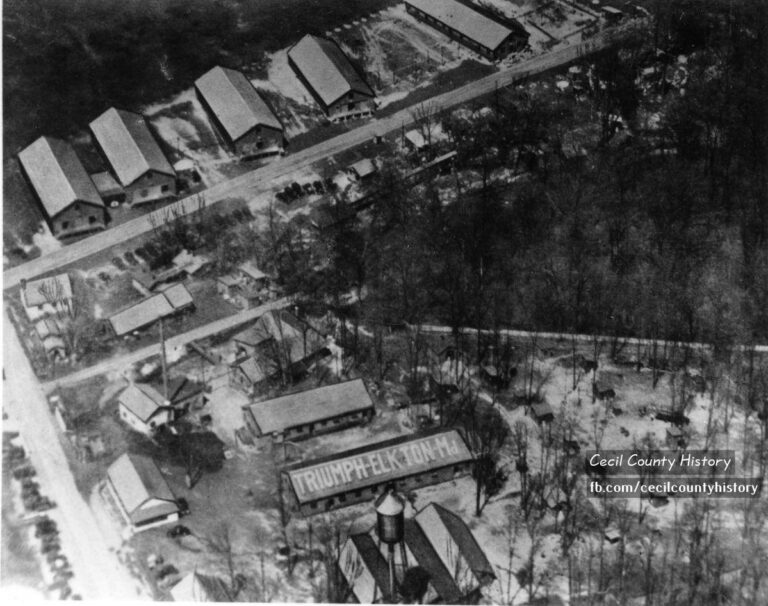
On the home front, they carried out dangerous assignments, producing munitions needed to win the war. People frequently talk about the big 1943 explosion at the munitions plants, but there were others, and a census or registry of civilian defense workers has never been compiled. It was perilous, and while non-fatal explosions occurred with some regularity, some were lethal.
Following what was described as Maryland’s worst munitions plant explosion in 1943, the Morning News wrote in an Editorial on May 5, 1943, “There is a little which can be said that will console the families who have lost one or more members as a result of this disaster. Yet, if they stop to reflect, they do have the comfort of knowing that their sons and daughters gave their lives just as surely and in a no less patriotic way than if they had died on the field of battle. They too were soldiers in the great cause to which America had dedicated itself and to the success of which it had pledged all its human and material resources.”4
According to our preliminary findings, at least twenty-two members of this group died in Elkton.
Feb. 21, 1940—Before the United States formally entered the war, two men lost their lives, and fourteen other employees were injured in an explosion that wrecked two buildings and damaged others at the Triumph Fusee and Fireworks Company plant. The plant employed approximately 500 people. For some time, the company had been chiefly engaged in manufacturing airplane flares and other pyrotechnic equipment under Government contracts. Sheriff David J. Randolph and Deputy Ralph W. Robinson rushed to the plant as soon as they heard the explosion after calling for state police assistance. Only one ambulance was available in Elkton, and it carried several of the injured to the hospital
- Edward Knief, 38, Newark, DE — died instantly.
- Charles Willard Gatchell, 32, of North East, died at Union Hospital
July 24, 1942—Victor Vardaro, 37, of Bear, died at Union Hospital the day after he received burns while closing the door to the power grinding room at the Elkton plant of Vardaro Fireworks Manufacturing Plant. Vardaro was the plant manager of the plant owned by his father, Alexander.5
- Victor Vardaro, 37, Bear, DE
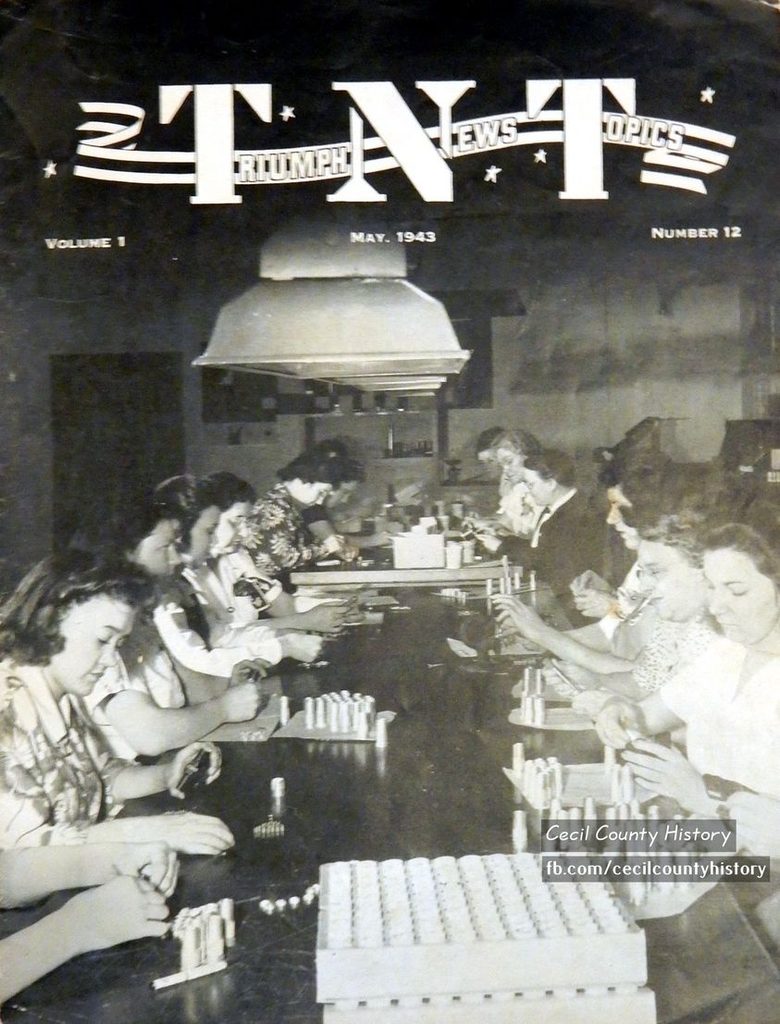
May 5, 1943—The state’s worst fireworks-munitions plant explosion killed fifteen workers and injured about 60 more. A series of blasts were followed by fires that destroyed two plant buildings and spread to three other Triumph Explosives, Inc structures.
The explosion occurred in a building that was used to manufacture tracer bullets. Seconds later, an adjoining building blew up. Fire companies from five communities aided plant firemen in battling the flames. Later, a fire broke out in a canteen filled with employees, resulting in many injuries.
The plant hospital was quickly filled, and a 25-bed Civil Defense Emergency Hospital was set up on the grounds, but the more seriously injured were rushed to Union Hospital. Throughout the night, medical personnel performed life-saving procedures. Later, Bodies were taken to the Pippin Funeral Home on East Main Street. Hundreds stood silently “outside under the old trees, which line the street,” as people entered the undertaking parlor to try to identify the dead.
Benjamin F. Pepper, the company’s president, appealed to the corporation’s 13,000 employees to return to work immediately. “We will do everything in our power to prevent any similar accident and to fight on with you harder than ever before,” was printed on red, white and blue signs posted in surrounding communities.
After a seventeen-hour shutdown, thousands of workers “hushed and grim-faced, slowly filed through the guard gates at Trumph Explosive. ending the seventeen-hour shutdown that followed the incident, the Evening Sun reported.6
- Willie Craddock, South Boston, VA.
- Mauhee Nediffer, Allentown Hills, WV.
- Susan Nolli, Eynon, PA
- Charles Millman, Camden, DE
- Della Truman, Cedar Grove, WV
- Ellis Simmons, Elkton
- Iva Young Ward, W.V
- Wilson Warner, Elkton
- Mrs. Hurley Galmore, Coatesville, PA
- Christine Erby, Raleigh NC
- Jake Peatross, Danville, VA
- Gilbert Poore, Warwick, MD.
- Harry Rias, Dover, DE
- Chester Whaley, Wilmington, DE
- Ivy Young, Ward, WV.
June 21, 1943—Three men died in a flash fire at Triumph. They were dumping defective waste material in what is known as a fire pit when an incident occurred.
- William Nelson Kellum, Carpenters Point
- Samuel Perkins, Still Pond
- William Smith, 37, North East
Sept. 6, 1943–An explosion of undetermined origin wrecked a small building at Triumph Explosive plant about noon, killing an 18-year-old employee.7
- Lester Billings, 18, Wilkesboro, NC
The registry probably represents an undercount, as the primary sources for this preliminary registry are city and local newspapers, and the papers may not have covered isolated incidents.
For more on the Triumph Fire Department, see this article.
- Maryland Historical Society, War Records Division, Maryland in World War II, vol. II (Baltimore: Maryland Historical Society, 1950), 427. National Magnesium opened on a 140-acre tract at Elkton in February 1942. The company produced magnesium powder for tracer shells, incendiary bombs, and signal flares on a 140-acre tract on the northwest edge of Elkton. It produced an estimated 7,500,000 pounds of magnesium powder before it closed in August 1945. ↩︎
- Maryland Historical Society, Maryland in World War II, II: 426. This firm concentrated on shells for the Army and Navy. Workers increased from a prewar 400 to a peak of 1,300 in January 1945. ↩︎
- Maryland Historical Society, Maryland in World War II, II: 429-430. Triumph’s wartime expansion was huge. Employees at the Elkton plant increased from a 1939 total of 211 to a March 1943 peak of about 11,500. ↩︎
- Morning News, Editorial, May 5, 1943. ↩︎
- Evening Star (Washington, D.C.), “Elkton Fireworks Plant Head Dies After Blast,” July 24, 1942. ↩︎
- Evening Sun, “Blast-Shaken Elkton Workers Return,” May 5, 1943. ↩︎
- The Herald-Mail, “Worker Killed by Elkton Explosion,” September 7, 1943. ↩︎
On Mon, May 28, 2018, 9:58 PM Window on Cecil County’s Past wrote:
> Mike Dixon posted: ” As this Memorial Day — the time to honor those who > died in the military while serving our country — draws to a close, we > also want to remember another group who made the ultimate sacrifice > defending our nation. These were Women Ordnance Worker” >
Was this the only ammo plant in the area??
Is it possible to get a list of employee names?? I believe my mother, Vivian L. O’Rourke (maiden name) or Vivian L. Biggs (married name) worked there. Appreciate learning more.
Teresa Hew
[email protected]
9032775111
There were a couple of plants, Teresa. National Fireworks Company was another one. And after there were a few more fireworks companies. As for employees, I don’t know where you can get a list. The best bet is to try searching the old newspapers online. https://chroniclingamerica.loc.gov is free. And then there’s http://www.newspapers.com, a subscription service.
As a child, I grew up there between Dogwood Road, RT 213, Blue all RD And the Elkton Newark hiway. Also this being now the year 2023. You can still find Military shell heads laying there. As a young teen, we found grenades, live grenades. Powder(s). In the 1970s alot of those building still stood there. When the Gov left the Victorian and the Triumph plant, alot of live shells and bombs had been left there. Same at Bainbridge, Mechanics valley road, and RT 7 between Elkton and NorthEast MD. Up aways in Cherry Hill MD, there was at the time another WWll area there as well. Across 213 Singerly road AKA Bridge Street there too was a plant there. Those buildings from time to time would shift, Then they would explode. I won’t say all that we as kids found there…..but alot was very deadly indeed. I e found alot of grenades there. But smart enough to leave them lay there. Told my dad about them. He dealt with it. He was a WWll vet. So yea he was experienced, I wasn’t. There used to be then aluminium cylinders that was about 8 inches tall with aluminium glass that opened from the sides. 3 pronged devices about 4 inches tall. Diameter an inch around with a pencil size cylinder up above it with a little pull ring at the top. Hell no I wouldn’t touch them. I knew better. My dad would have my tail end if I messed with that stuff. Alot of us kids would ride our bikes over there, play in those buildings. Never hurt the land in anyway. There was our play yard. Older teen used some of those buildings for their cabin so to speak. All was great until the 1970’s when so dumb ass older teen hit a grenade with a baseball bat. Well needless to say, there on the planet someplace unknown. Yea,they killed themselves out of stupidity. That powder goes back to in cut nitro. Very very unstable. Not good to play with it, let alone even get near it. A spark from jingling keys WILL certainly set it off. I know where things a buried there, but I won’t tell people where it’s buried at. To many lives could be harmed. I think Davitt builders own the Triumph plant now there in Elkton. Don’t get caught trespassing there now. He may not like that. In the 1950’s there, people stole mercury, copper wire, some of the buildings, abandoned vehicles that had been left behind. Mainly for their engines and body parts. There’s still an ammo dump there. Buried, but it’s there. It can stay right where it’s at too. We found short fat brass shells, tall narrow brass shells. Suits gloves, shoes from the chem plant. This is just some of the things that we found. Again, I won’t list all. Is there still live things there from WWll? Possibly…